
 PFAS
PFAS
Per- and Polyfluoroalkyl Substances include nearly every substance containing fluorine Per- and Polyfluoroalkyl Substances are a group of over 10,000 fluorinated substances including stable fluoropolymers such as FKM, FFKM and PTFE which are used as critical seat and seal materials in many Swagelok products. There is only one definition for PFAS, Per- and Polyfluoroalkyl Substances, which includes nearly every substance containing fluorine.
Fluorine has the highest electronegativity of any atom meaning that it forms the strongest possible bonds in organic molecules (molecules having a carbon backbone). Polymers containing fluorine such as PTFE, FFKM and FKM have extreme chemical and temperature resistance. Due to the unique properties of fluorine, fluoropolymers are irreplaceable (without reducing performance).
Research indicates that not all fluorochemicals should be regarded as the same. Not all fluorochemicals have been proven to be hazardous to health nor do they all bioaccumulate. Fluoropolymers, specifically, have been proven to be of low concern (PLC). Some short chain fluorochemicals (primarily C8) have been linked to health hazards and/or bioaccumulation. Major fluoropolymer manufacturers have voluntarily committed to reduce non-polymeric PFAS emissions (2024: 0.009% to air; 0.001% to water; 2030: 0.003% to air; 0.0006% to water*)
Many Swagelok products have seat and seal options for fluid systems that do not require the elevated chemical and temperature resistance that fluorinated seat and seal materials provide. Due to the absence of fluorine in these seat and seal options, product temperature ratings with these options are typically lower than the standard rating.
 Seat and seal materials that are PFAS-free
- PEEK
- Polyimide (i.e. Vespel®)
- UHMWPE
- Alloy X-750
- Nitrile (i.e. Buna-N, Buna-C)
- Ethylene Propylene Rubber
- Polychloroprene (i.e. Neoprene)
Seat and seal materials that contain PFAS
- PTFE
- PFA
- PCTFE
- FKM (i.e. Viton)
- FFKM (i.e. Kalrez®, Simriz®, Perlast®, Chemraz®)
Examples of PFAS Free Product Options:
Swagelok 60 Series Ball Valve
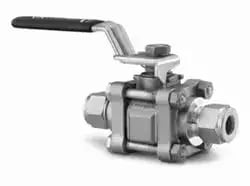
- Alloy X-750
- PEEK
- UHMWPE
- Nitrile (i.e. Buna-N, Buna-C)
- Ethylene Propylene Rubber
- Polychloroprene (i.e. Neoprene)
- Note: stem gland is PTFE coated
Swagelok C Series Check Valve
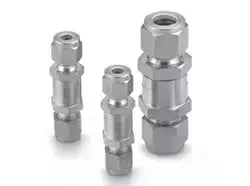
- Nitrile (i.e. Buna-N, Buna-C)
- Ethylene Propylene Rubber
- Polychloroprene (i.e. Neoprene)
- Note: the inlet gasket is PTFE coated on valves requiring an inlet gasket
