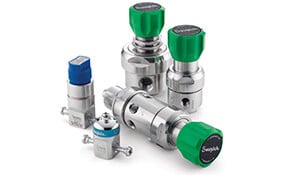
The Art of Selecting Pressure Regulators: System Insight Over Intuition
When you select a pressure regulator, you’re not just choosing a single component. You’re making a decision that directly affects the stability, accuracy, and reliability of the entire system. In practice, this choice is still too often simplified to a few familiar parameters, such as inlet pressure, outlet pressure, and sometimes a Cv value. But that’s not the whole story. A good selection always starts with understanding the entire application.
A Swagelok engineer sees this in practice on a regular basis. At first glance, the question may seem simple, but behind every request lies a technical landscape in which multiple factors play a decisive role simultaneously. For example, it makes a big difference whether you’re regulating a liquid or a gas. With gases, properties such as molecular behavior and compressibility play a role. With liquids, you’re more likely to look at density and viscosity. Pressure and temperature are, of course, important input values as well, but only when combined with pipe diameter, material selection, and the expected process dynamics does a realistic picture emerge of what a regulator actually needs to do.
“Selecting the right pressure regulator doesn’t start with the product sheet, but with understanding the process.”

Swagelok Field Engineer
Why is standard selection data often insufficient?
In many inquiries, a few key values are provided, and that seems sufficient to make a decision. However, that is usually not enough. After all, a pressure regulator responds not only to a set pressure but to every change in the system. As soon as the flow increases or decreases, the supply pressure fluctuates, or the resistance in the pipe changes, the regulator’s behavior changes as well.
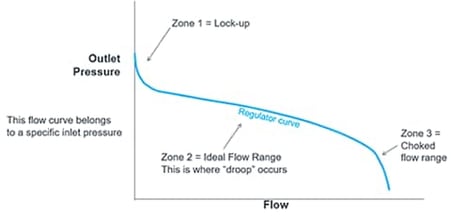
That difference is essential. Because a regulator that seems suitable on paper may, in reality, fall out of its effective control range too early. This can lead to pressure losses, instability, or undesirable deviations in the outlet pressure—and that is precisely what you want to avoid in a critical process.
“It’s not the theoretical maximum value, but how it performs in the operating range that determines whether a pressure regulator is truly suitable.”
Swagelok Field Engineer
The parameter that is often overlooked in practice
One of the most underestimated factors affecting pressure regulators is the effect of changing inlet pressure. In many applications, it is assumed that a set outlet pressure remains constant as long as no one adjusts the knob. In practice, however, things work differently. As soon as the pressure on the inlet side drops or rises, the outlet pressure can change accordingly. This phenomenon is known as the Supply Pressure Effect, often abbreviated as SPE.
Precisely because this effect is not always immediately apparent, it is frequently overlooked during the design phase. Yet it can have significant consequences, especially in processes that operate at low pressures or with tight tolerances. In such applications, even a slight change can be enough to noticeably affect the process outcome.
This does not necessarily make SPE a problem in every system, but it is a factor that must be consciously taken into account. In many standard applications, the effect is manageable and not critical. In precision processes, such as inert gas use or welding applications, however, the same effect can be directly visible in the quality of the final result.
A striking real-world example comes from an application involving argon in orbital welding. As the cylinder became emptier, the inlet pressure dropped. At the same time, the outlet pressure rose slightly. That change was small, but significant enough to affect the weld pattern. This precisely illustrates how important it is to take even seemingly minor pressure changes seriously.
“The supply pressure effect is often not a major problem, but it is exactly the kind of detail that can throw a critical process out of balance.”
Swagelok Field Engineer
How can a loss of performance be prevented?
When selecting a pressure regulator, the dimensions are still too often chosen to be too small. Problems frequently occur on the outlet side in particular. A flow orifice that is too small or too much resistance in the downstream section can cause a greater pressure drop across the regulator than desired. On paper, everything may still seem acceptable, but in operation, the system then fails to deliver the required performance.
This problem lies not only in the regulator itself but also in everything connected to it. The piping downstream of the regulator, the inner diameter of the connection, and any additional components collectively determine how much resistance the fluid encounters. Anyone who fails to factor these elements into the calculation is essentially looking at an incomplete system.
The consequences are clearly noticeable: the desired flow does not materialize, the outlet pressure drops further than expected, and the system responds less stably. This occurs especially when users select components based on nominal dimensions without properly calculating the effective outlet capacity. Discussions about performance could often have been avoided as early as the design phase.
“The performance of a pressure regulator is partly determined by the system behind it.”
Swagelok Field Engineer
An oversized regulator is undesirable
While a valve that is too small causes pressure loss, a valve that is too large can cause a different problem. In that case, the valve barely opens to meet the required process conditions. That may sound safe, but in reality, it is precisely then that instability can arise.
When a control valve needs to open only very slightly to meet demand, the control mechanism can become erratic. The valve then responds too quickly and too frequently to small changes. In practice, this can lead to what is known as “chatter”: a fluttering or flapping motion of the valve element. This not only produces an annoying noise but also causes wear and potential damage to the valve over time.
“Oversizing feels safe, but in pressure control, it’s often the quickest path to instability.”
Swagelok Field Engineer
When a single pressure stage isn’t enough
In some applications, the pressure drop is so large that a single regulator cannot perform the task optimally. Consider, for example, a range from 200 bar to 1 bar. Such a large step in a single step is often technically undesirable, and in many cases simply not the best choice.
This requires multi-stage solutions. In a two-stage system, the initial large pressure reduction is handled in the first stage, after which a second stage further reduces the pressure to the desired level. This provides greater control and reduces the risk of undesirable side effects.
Why this is important becomes clear as soon as you look at what happens physically inside the regulator. A large pressure drop across a small orifice results in high velocities. This can lead to significant cooling of the medium and, in some cases, even to the regulator freezing. In addition, that high velocity can cause erosion in the seat or on other critical surfaces. The regulator may continue to function initially, but it wears out faster and eventually loses its sealing ability.
“When the pressure drop is too large, a single regulator isn’t always the best solution. By spreading the pressure reduction over multiple stages, the system remains more manageable.”
Swagelok Field Engineer
The entire system determines performance
A pressure regulator is always part of a larger system. What happens before and after it is just as important as the regulator itself. This applies to piping, valves, filters, and even the quality of the installation.
Installing a filter upstream of the pressure regulator protects critical internal components from contamination and contributes to stable, accurate, and reliable pressure regulation.
In many systems, small contaminants are present, such as tape residue, welding particles, metal shavings, or other debris from the piping. As soon as these enter the regulator’s seat, the risk of damage and leakage increases significantly. A properly selected filter protects the regulator from contamination without introducing unwanted pressure drops or flow restrictions.
The same applies to valves. A valve upstream of the regulator that is too small can restrict the available flow and thus affect performance downstream. In such situations, the regulator is not the cause of the problem, but rather the point where the problem becomes apparent.
“If you only look at the controller, you often don’t notice the problem until the system is already running.”
Swagelok Field Engineer
Stability is not an option, but a key design requirement
As soon as a system becomes more sensitive to pressure variations, the focus shifts from mere functionality to stable operation. The question then becomes not only whether a controller can achieve the desired pressure, but above all how consistently it can maintain that pressure as the flow changes.
This is where the droop curve comes into play. This curve shows how the outlet pressure changes as the flow rate decreases. In the ideal operating range, that line remains as flat as possible. This means that the controller maintains a stable outlet pressure even as flow changes. As soon as the curve begins to drop more steeply, you leave the effective control range and accuracy decreases.
For many standard applications, a spring-loaded pressure regulator is an excellent solution. But as pressure stability becomes more critical, a dome-loaded or pilot-operated configuration can offer added value. It maintains a flatter pressure curve over a wider range and is less sensitive to changes in flow.
“Not every application requires the most advanced controller, but every critical application does require stability.”
Swagelok Field Engineer
Performance, costs, and the trade-off that’s often overlooked
In practice, the purchase price is often the first factor considered during the selection process. That makes sense, but it isn’t always the wisest approach. The cheapest solution at the component level is by no means always the most cost-effective at the system level.
A pressure control system designed for greater stability may be more expensive to purchase but actually more cost-effective to operate. Fewer deviations, fewer breakdowns, less product loss, and less need for readjustment yield immediate returns in many environments. Especially when product quality or process continuity are critical, the controller’s performance is often more important than the initial investment.
“A better regulator may require a higher upfront investment, but it often reduces costs in the long run.”
Swagelok Field Engineer
Insights
The selection of a pressure regulator always starts with the application, not with a standard product specification. Pressure, temperature, medium, pipe diameter, and material must be evaluated together to make a reliable choice.
A common mistake is that engineers or users pay too little attention to the supply pressure effect. Especially in sensitive applications, a small change in inlet pressure can lead to a noticeable change in outlet pressure and, consequently, to quality issues in the process.
Sizing also requires precision. A regulator that is too small or an outlet that is too small causes unnecessary pressure drop and limits performance. Conversely, a regulator that is too large can lead to chatter, instability, and accelerated wear.
For large pressure reductions, a multi-stage solution is often necessary to limit cooling, erosion, and performance loss. Additionally, a pressure regulator is always part of a larger system. Filters, valves, and piping directly influence the system’s ultimate behavior.
Finally, stability is a fundamental design requirement. Anyone who wants a process to run reliably must not only ask whether the desired pressure is achievable, but above all how stable that pressure remains under varying conditions.
Troubleshooting Common Pressure Regulator Problems in Systems

How to Manage the Supply Pressure Effect in Industrial Gas Regulators