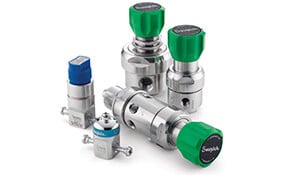
Maintenance and Reliability of Pressure Regulators: Tips for Optimal Performance
In many systems, pressure regulator maintenance does not receive the attention it deserves, even though these components are constantly in motion. They respond to every change in pressure and flow, thereby functioning as the dynamic heart of the system.
Yet maintenance is often only discussed when problems arise—and by then, it may be too late. With the right approach, you can prevent many malfunctions and significantly extend the service life of your system.
“A pressure regulator operates continuously. If you treat it as a static component, you’ll run into problems sooner or later.”

Swagelok Field Engineer
Why Maintenance Doesn’t Have a Fixed Interval
A frequently asked question is how often a pressure regulator requires maintenance. The honest answer is that there is no standard interval for this. The service life of components such as O-rings, seats, and poppets depends heavily on the conditions under which they are used.
Factors such as the type of fluid, temperature, viscosity, and pressure fluctuations play a major role here. The usage pattern is also a determining factor. A regulator that is continuously active wears out differently than one that is used sporadically.
Therefore, maintenance is not a fixed time interval but a process that adapts to the application. In practice, this is often based on experience. In systems that have been in operation for some time, engineers usually know well when maintenance is needed. But in many cases, that experience is lacking, and maintenance is postponed or even skipped entirely.
“Maintenance isn’t a scheduled activity, but a process that you need to tailor to your application.”
Swagelok Field Engineer
Overhaul or Replace: What’s the Best Choice?
When it comes to maintenance, the question often arises as to whether a pressure regulator should be overhauled or completely replaced. Both options have their pros and cons, and the best choice depends on the situation.
Overhaul means that the regulator is disassembled, cleaned, and fitted with new wear parts. This can be cost-effective and extends the service life. At the same time, it carries risks. Incorrect assembly, damaged parts, or the use of the wrong tools can lead to new problems.
Replacement, on the other hand, offers certainty. A new controller operates according to specifications and minimizes the risk of installation errors. In critical processes, where downtime is costly, this may be the safest and most efficient solution.
“Sometimes it’s cheaper to overhaul. Sometimes it makes more sense to replace. The right choice always depends on the impact on the process.”
Swagelok Field Engineer
Recognize the warning signs before a regulator fails
A pressure regulator rarely fails without warning. In many cases, there are clear signs indicating that maintenance is needed. Recognizing these signs helps resolve problems early on.
One of the first signs is noise. When a regulator begins to “chatter” or produce a fluttering sound, this often indicates wear or a poor seal. This behavior points to instability and requires immediate attention.
Pressure deviations are also an important indicator. If the regulator can no longer maintain the set pressure or if the pressure slowly increases, this may indicate an internal leak, such as one caused by creep. This means the seal is no longer closing completely.
“Pressure regulators require attention. Keeping spare parts in stock helps prevent unnecessary downtime.”
Swagelok Field Engineer
Inventory Management: An Underestimated Success Factor
In many organizations, the focus is primarily on purchasing the pressure regulators themselves. What is often overlooked is the importance of spare parts. Especially with dynamic components such as pressure regulators, it is essential to be prepared for maintenance.
A small part like an O-ring can make the difference between a properly functioning system and a complete shutdown. If this part is not in stock, the process comes to a standstill until a replacement is available.
“The smallest part can cause the biggest shutdown.”
Swagelok Field Engineer
Differences Between Industries: Less Significant Than Expected
It is often assumed that the requirements for pressure regulators vary greatly from one industry to another. In practice, this is not the case. The basic principles remain virtually the same. What really matters is not the sector, but the medium and the process conditions.
Whether it’s the chemical, semiconductor, or energy industries, the most important questions remain the same: What medium is being used? How corrosive is it? What pressure and temperature conditions are involved? How critical is stability?
“Where cleanliness is critical, every component must help prevent contamination.”
Swagelok Field Engineer
The Future of Pressure Control: Greater Insight and Control
Although the basic principles of pressure regulators have remained the same for decades, we are seeing developments in the areas of monitoring and control. Mechanical regulators are increasingly being combined with electronic systems.
Consider, for example, sensors that continuously measure pressure and transmit this information to a control system. These systems can automatically make adjustments and ensure an even more stable process.
“The future of pressure control lies in the combination of mechanics and data.”
Swagelok Field Engineer
The Biggest Challenge: Knowledge Retention in the Industry
One of the biggest challenges for engineers is not technology, but knowledge. In many organizations, experience is lost as seasoned employees leave. At the same time, new hires are joining the workforce and have yet to build up this knowledge.
This leads to a knowledge gap. Basic principles such as the supply pressure effect, droop, and creep are not always understood, even though they are essential for a properly functioning system.
“The technology isn’t the problem. It’s often the lack of experience and knowledge.”
Swagelok Field Engineer
Why Contamination Keeps Coming Back
Despite all the knowledge and documentation, contamination remains the leading cause of problems. This is because it is not only a technical problem but also a human one.
Even if a system is perfectly designed, contamination can still occur during use. Consider changing gas cylinders. When hoses fall to the ground or are not cleaned properly, contaminants enter the system.
“Even a well-thought-out design can fail due to improper procedures or incorrect actions.”
Swagelok Field Engineer
Conclusion
Pressure regulators may seem like simple components, but in reality, they are a very important part of any industrial system. Those who understand them well and apply them correctly lay the foundation for safety, stability, and efficiency.
“A properly functioning pressure regulator goes unnoticed. But if it isn’t working right, you’ll notice it right away.”
Swagelok Field Engineer

You don't choose the right pressure regulator based on a hunch, but on an understanding of the system
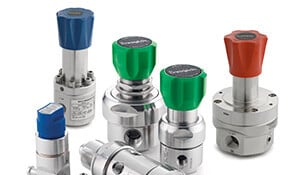
Pressure Control: The Invisible Foundation for Stable Industrial Processes