
Why Pressure Regulators Are Often Wrongly Considered Defective
In theory, pressure regulators function exactly as designed. In practice, however, problems can arise. Interestingly, the cause is rarely the regulator itself. Much more often, the problem lies in contamination, system design, or incorrect assumptions about the system’s behavior.
“Most of the pressure regulators that are returned aren’t defective. They’re just dirty.”

Swagelok Field Engineer
This insight is very important. Because anyone who thinks the problem lies in the regulator will be looking in the wrong place. Meanwhile, the real cause is often already present in the system.
The number one cause: contamination in the system
Practical experience shows that the vast majority of “defective” pressure regulators are actually suffering from contamination. In some cases, this accounts for more than eighty percent of returned products. That contamination almost always originates from the system itself.
The sources are varied but recognizable. Think of sealing materials, such as tape used on threaded connections. When applied incorrectly, small particles can break loose and end up inside the regulator. The same applies to welding. During assembly, small metal particles are generated and are then carried along through the pipe.
“Even a single tiny particle on the seat is enough to make a perfect seal impossible.”
Swagelok Field Engineer
Precisely because this contamination is so small, its impact is often underestimated. Yet the effect is significant. A pressure regulator is designed to operate with minimal tolerances. Any disruption to that precision directly leads to deviations in performance.
The role of filters: essential, but often misapplied
The most obvious solution to contamination is to install a filter upstream of the pressure regulator. And yet, in practice, this is regularly overlooked or implemented incorrectly.
A properly selected filter protects the regulator from contaminants and significantly extends its service life. It prevents damage to the seat and reduces the risk of leakage or unstable performance.
“A filter solves a lot of problems, but only if it’s chosen carefully and properly integrated into the system.”
Swagelok Field Engineer
Real-world complaints: what operators actually experience
The problems operators report often provide a good picture of what is happening in the system. It is striking that these complaints do not always point directly to the actual cause.
A common complaint is that the pressure “suddenly rises” or, conversely, drops for no apparent reason. In many cases, this turns out to be due to the supply pressure effect. The pressure on the inlet side changes, and the regulator responds accordingly. To the user, this feels unpredictable, even though it is actually a well-known physical phenomenon.
“The problem lies at the back end of the system, but the cause is often at the front end.”
Swagelok Field Engineer
This makes troubleshooting more complex than it seems. It requires an understanding of the entire system, not just the regulator.
When the problem is not a pressure regulator issue
An important insight from practical experience is that many so-called regulator problems are actually system problems. In such cases, the regulator is not the cause, but merely the point where the problem becomes apparent.
A classic example is a filter that is too small or a pipe on the outlet side that is too small. These restrict flow, preventing the desired pressure from being achieved. To the user, it appears as though the regulator is failing, but in reality, the problem lies downstream.
“The regulator shows what’s going wrong in the system, but is rarely the cause itself.”
Swagelok Field Engineer
Frequent readjustments? That’s an important sign
In many installations, operators regularly readjust the pressure. Sometimes this is viewed as a routine task. In reality, it is an important signal that something is not optimally tuned.
In simple applications, readjustment may be acceptable. When requirements are low and minor variations are not a problem, this is part of normal operation. But in critical processes, a pressure regulator should function stably without continuous corrections.
“Proper pressure control doesn’t require constant attention. If you have to keep making adjustments, something isn’t right.”
Swagelok Field Engineer
This means that readjustment behavior is a valuable indicator. It is not a symptom to be accepted, but a signal that warrants investigation.
Pulsations: An Underestimated Disturbance in the System
In addition to fouling and incorrect selection, pulsations are a major source of instability. Pulsations occur, for example, in pumps or compressors and cause rapid pressure fluctuations in the system.
This poses a particular challenge for pressure regulators. They are designed to accommodate gradual changes, not to continuously respond to rapid peaks and troughs. As a result, the regulator may begin to oscillate, constantly opening and closing.
This behavior closely resembles a malfunction, but is in reality a response to the conditions. In extreme cases, a backpressure regulator may even function as a sort of relay, opening fully with every pulsation.
“Pulsations have no place in a system with pressure regulators. If they occur, it is advisable to investigate the cause.”
Swagelok Field Engineer
Small Particles, Big Impact
One of the most underestimated aspects of pressure control is the impact of microcontaminants. Particles as small as a few microns can be enough to cause damage.
At high gas flow rates, these particles act as an abrasive. They move at high speed across the seat and cause wear. This is often compared to a sandblasting effect. The surface becomes damaged, causing the seal to no longer function optimally.
“Creep starts small, but its impact can be enormous.”
Swagelok Field Engineer
Precisely because this process occurs gradually, it often goes unnoticed for a long time—until the damage becomes apparent in the form of instability or even system failure.
Material Selection: The Silent Factor Behind Reliability
In addition to contamination and system design, material selection plays a key role in the reliability of pressure regulators. Not every material is suitable for every medium. What works excellently in one application may not be suitable in another environment.
Corrosive media, high temperatures, or specific gases place special demands on both the regulator’s “housing” and its internal components. Seals such as O-rings and seats are particularly sensitive to incorrect material choices.
A material that is stable at lower temperatures may lose its properties at higher temperatures. This can lead to leaks, deformation, or even failure of the seal.
“You don’t notice the right material; the wrong one, all the more so.”
Swagelok Field Engineer
Specific Challenges: Hydrogen and Corrosive Media
Some media place particularly high demands on the system. Hydrogen is a good example of this. This gas has unique properties that affect sealing materials and structural materials.
Under high pressure and rapid pressure changes, O-rings can become damaged or even rupture. Additionally, hydrogen embrittlement plays a role in certain metals. This can compromise the structural integrity of components.
To prevent this, specific material selections are made. Examples include alloys with a higher nickel content, which are more resistant to these effects. Special materials are also used for seals that better withstand these conditions.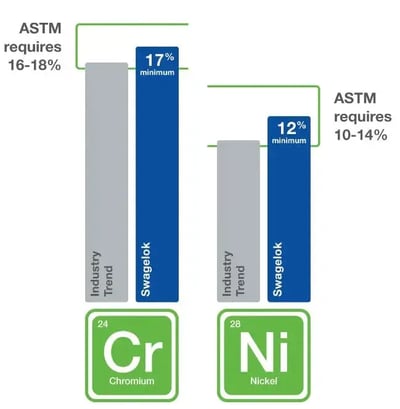
“In demanding environments, the choice of materials determines both the system’s lifespan and its safety.”
Swagelok Field Engineer
The Role of Seats and Elastomers
In a pressure regulator, the seal plays a central role. It is formed by the combination of the poppet and the seat. Together, they ensure that the pressure is regulated correctly and that the system seals when necessary.
The seat can be made of various materials, depending on the application. This can be a metal, but also a polymer such as PTFE. The choice determines not only the seal but also the wear resistance and compatibility with the medium.
“In the end, it’s the smallest components that determine the greatest performance.”
Swagelok Field Engineer
Key Insights
Most problems with pressure regulators are caused by external factors, not by the regulator itself. Contamination is the primary cause. Small particles from the system can lead to leaks and wear.
Filters help prevent these problems, provided they are carefully selected and do not create additional resistance. Issues such as pressure fluctuations or leaks are often related to system design, for example due to the supply pressure effect or contamination.
Sizing and system design also have a direct impact on performance. Pipes, filters, or valves that are too small can limit operation. Pulsations are also a major source of instability and must be actively damped.
Finally, the choice of materials is essential for reliability and safety. Especially with demanding media or hydrogen applications, this determines whether a system operates reliably and safely.
Pressure Control: The Invisible Foundation for Stable Industrial Processes
Maintenance and Reliability: How to Keep Pressure Regulators in Top Condition