
Well-chosen and properly installed pressure regulators make the difference between stability and risk
Pressure regulators are present in many industrial installations, but they rarely take center stage. They remain in the background, both literally and figuratively. Yet their impact should not be underestimated. Anyone who delves into the role of pressure regulation quickly discovers that these components have a direct impact on safety, product quality, energy consumption, and process continuity.
“Pressure regulators may not always be visible, but they play a major role in determining how stable and safe your process operates.”

Swagelok Field Engineer
In this knowledge base session, we’ll delve into pressure regulation. We’ll translate practical experiences into concrete insights and help you understand where the greatest risks and opportunities lie.
Why Pressure Regulators Are More Important Than Often Realized
Pressure regulators are often viewed as simple components that are “just part of the system.” In reality, they are an essential part of process control. As soon as a pressure regulator fails to function optimally, this directly results in a loss of system performance.
Consider, for example, situations where the pressure does not remain constant. This can lead to variations in product quality, inefficient energy use, and in some cases even safety risks. A small deviation can have major consequences.
The crux of the matter lies in the fact that pressure regulation is always dynamic. The system continuously responds to changes in flow, pressure, and demand.
“A pressure regulator is not a valve that is either open or closed. It is a continuously operating system that constantly adapts to the process.”
Swagelok Field Engineer
Common Misconceptions That Lead to Problems
In practice, this often leads to inefficiency and unpredictable system behavior.
“A pressure regulator controls pressure. As soon as you use it to control flow, you’re essentially asking it to do something it wasn’t designed to do.”
Swagelok Field Engineer
Another common misconception lies in selecting the right regulator. Engineers sometimes base their choices on standard values such as Cv (flow coefficient), whereas in reality, the full flow curve provides a much more reliable picture of performance.
The difference may seem technical, but the impact is significant. The flow curve shows how a controller behaves under various conditions, whereas a single Cv value is merely a snapshot.
Assumptions That Later Lead to Costly Errors
In engineering projects, assumptions are often made to keep the design process moving quickly. This is understandable, but it can be risky when it comes to pressure regulators.
A common assumption is that a regulator behaves the same way under all conditions. In reality, factors such as pipe diameter, material selection, and type of medium play a major role.
“Choosing the right pressure regulator doesn’t start with the product, but with a thorough understanding of the application.”
Swagelok Field Engineer
This means you should consider not only pressure values but also temperature, medium properties, and variations in flow.
Installation errors: small details, big consequences
Even when the correct regulator has been selected, a lot can still go wrong during installation. And that is precisely where problems often arise that are difficult to trace.
In addition, the mounting position plays an important role, especially for regulators that are sensitive to low pressure. Incorrect orientation can prevent the regulator from responding correctly to pressure changes.
“Installation may seem like a simple step, but it’s precisely where theory and practice come together.”
Swagelok Field Engineer
Precise installation is therefore just as important as selecting the right component.
How a Pressure Regulator Actually Works
To truly grasp pressure regulation, it’s important to understand the basic principles. Although the technology may seem advanced, the underlying mechanism is relatively simple.
When the pressure beneath the diaphragm changes, the system reacts immediately by adjusting the flow rate. This process occurs continuously and fully automatically.
“It’s a simple principle, but its impact is anything but simple.”
Swagelok Field Engineer
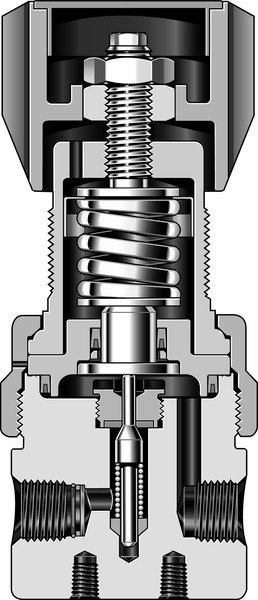
What is the difference between pressure-reducing and backpressure regulators?
There are various types of regulators used in pressure control, each with a specific function. Two of the most commonly used are pressure-reducing and backpressure regulators.
“Having the right controller in the right place isn’t just a minor detail—it’s essential for a system to function properly.”
Swagelok Field Engineer
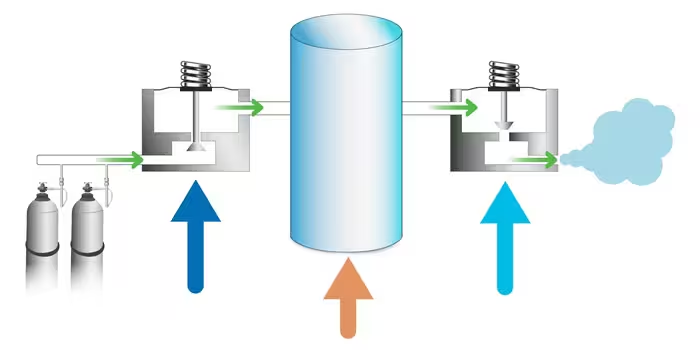 Pressure-Reducing Regulator Process Back-Pressure Regulator
Accuracy and Stability: When Should You Choose Which Type of Regulator?
Not every application requires the same level of accuracy. In simple systems, a manually operated spring-loaded pressure regulator is often sufficient. It is robust and relatively easy to use.
Dome-loaded and pilot-operated regulators offer more stable control because they are less sensitive to fluctuations in flow. They maintain a more constant pressure and respond more accurately to changes.
“The more critical your process, the more important the stability of your pressure control becomes.”
Swagelok Field Engineer
Choosing the right type always depends on the process requirements. It is not a matter of “better” or “worse,” but of “suitable” or “unsuitable.”
Practical Approach: How to Make the Right Selection
In practice, a good selection always starts with asking the right questions—not about the product, but about the application.
-
What pressure is required?
-
What are the temperature conditions?
-
What medium is used?
-
Are there variations in flow?
-
Are there any safety risks?
“Understanding the application is the key to a sustainable solution.”
Swagelok Field Engineer
The impact of pressure regulation on your overall process
When pressure regulators are functioning optimally, you don’t notice it right away. Everything works as expected. That, in fact, is the sign that everything is going well.
That’s why it pays to view pressure control not as an afterthought, but as an integral part of process optimization. It’s a relatively small investment with the potential for a major impact.
Key Insights
A solid understanding of pressure control helps you make better decisions and mitigate risks.
In Conclusion
Pressure control may not be a topic that immediately captures the imagination, but it is a cornerstone of virtually every industrial installation. By managing it effectively, you can not only prevent problems but also improve performance and better control costs.
“You can’t see the best pressure control. You feel it in the stability of your process.”
Swagelok Field Engineer

You don't choose the right pressure regulator based on a hunch, but on an understanding of the system
Maintenance and Reliability: How to Keep Pressure Regulators in Top Condition