Understanding modern gas distribution systems: part 4

Knowledge Base
Risk Management in Gas Distribution Systems: Safe Design, Leak Detection and Practical Standardization
7:53

In this session, the 4th part, you will discuss in detail how to practically manage risks and make thoughtful choices around safety and efficiency. You will learn how to proceed structurally: from detecting leaks and performing audits to prioritizing improvement measures and selecting the right materials and joining techniques. Focusing on clear communication, expert maintenance and continuous evaluation prevents systems from becoming unnecessarily complex or costly.

Safety, leakage and risk management are essential concerns in the management of gas distribution systems.

As installations age or processes change, potential risks increase: from undetected leaks and malfunctions to incidents that impact operations and safety. This chapter explains the challenges of transitioning from supply to internal network, how to recognize and prevent leaks, and what measures contribute to a safe and reliable system. Practical lessons from audits, brownfield projects and material and design choices offer insight into minimizing risk and ensuring continuous operational reliability. This makes clear why vigilance and proper maintenance are vital at every stage of the system.

What design choices make the biggest difference?
The main distinction is obtained by carefully identifying with end users what pressure ranges are actually required, how they handle valves and where flexibility is essential. It also addresses accessibility when replacing gas wells. Based on this information, a standard solution is adapted and optimized for their specific working methods.

What installation and standardization errors are common?
Many installations use identical copper piping and soldered connections for a variety of gases, usually because future growth was not adequately considered during construction. Redundant wire transitions create complex structures that can easily be replaced with a suitable fitting. Often, end users try to improve their systems on their own initiative. Although they have good intentions, they do not always have sufficient technical knowledge, which can lead to unsafe or inefficient situations.

What recurring deficiencies do auditors see?
Auditors frequently note that end users have difficulty accessing certain areas or cannot work safely with current systems. Since they are not allowed to provide solutions themselves, they usually refer to QHSE or a safety expert. It is recommended that facility management work with a specialized vendor in a timely manner to see how systems can be made safer and more efficient.

Which leak detection methods are most effective in practice?
Although leak detection fluid and sniffers are effective, they are rarely used. Often a gas leak is not detected until consumption suddenly increases. End users can recognize problems faster if they understand how the system works. Training and awareness play a major role here.

How are hydrogen, helium and other small molecules handled?
For these gases, connections are kept to a minimum and piping is orbital welded where possible to reduce the risk of leakage. The goal is to develop a distribution system that provides equal functionality to existing alternatives while increasing safety and reducing the number of potential leaks.

What material choices are important with permeation-sensitive gases?
Preferably, choose 316 stainless steel. Copper is sometimes chosen at low pressures, but leaks are difficult to detect with light molecules. Consult specialists for safe and appropriate material selection.

When do you choose orbital welding joints instead of mechanical joints?
Orbital welding technology is used when a high degree of purity is required and it is believed that the joint will not undergo further processing. Mechanical joints usually work fine, but they can still be altered or manipulated. In systems involving hazardous or pure gases, welding is often deliberately chosen.

Swagelok material selection guide
"Safety, leakage and risk management are the important issues within the management of gas distribution systems. As installations age or processes change, potential risks increase: from undetected leaks and malfunctions to incidents that impact operations and safety. This shows why vigilance and proper maintenance are vital at every stage of the system."

Swagelok-Icon-SVG

Swagelok Nederland

Sales Engineer

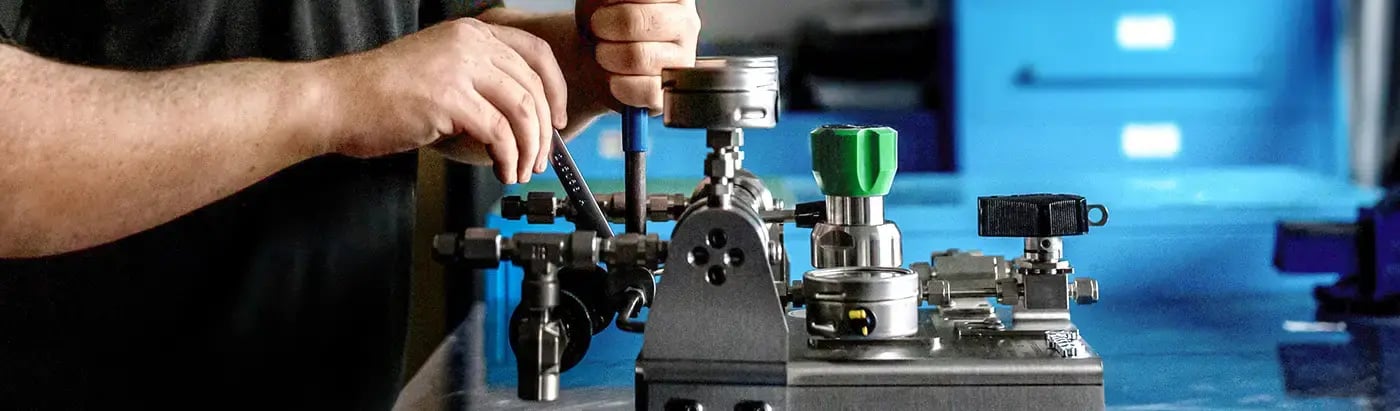
gas distribution assembly

Standards and audits are essential to the safety and operational reliability of gas distribution systems.

In the world of gas distribution systems, standards and audits are an indispensable basis for safety and operational reliability. Working according to clear regulations and guidelines not only ensures compliance with legal requirements, but also contributes structurally to minimizing risks. Audits and inspections also force organizations to critically scrutinize processes, documentation and systems and continuously improve them. This section explains how standards are put into practice, where the biggest challenges lie in audit processes and how standardization can make the difference in preventing unsafe situations and simplifying management. This creates a solid foundation on which safety, reliability and transparency can be guaranteed within gas distribution systems.

How do you stay audit proof without falling into over engineering?
By keeping systems simple and standardized. If components and construction are the same everywhere, a clear story emerges towards auditors: you can explain why choices were made and how standardization supports safety, stability and manageability.
Complex or inconsistent systems require extensive documentation and create ambiguity during audits. Simple, uniform configurations remain more manageable - even when personnel change.

Which standards are leading in different industries, and is there overlap?
Building standards are usually leading, supplemented by standards that deal specifically with gas use in buildings. These are usually followed up by facility management and QHSE.
For specialty gases, it is sometimes searching for exactly which standard applies, but in practice the legal requirements are less stringent than the recommendations advised in a professional engineering approach. As a result, few conflicts arise between standardization and best practices.

What audit findings are most common?
The most common problem is an unsafe or impractical situation at the end user's workstation.
This is often because users make their own modifications, or because their workspace was not properly considered in the original design. As a result, they cannot perform their tasks safely or correctly with the resources available.

What documentation is most often missing during inspections?
Much missing documentation occurs because modifications over the years are not recorded.
The main drawings of the main network are usually in order, but at user points, different employees have made changes in their own way without documenting them. This lacks just the level of detail that auditors want to see.
Standardization helps tremendously here, because a uniform structure is much easier to record and maintain centrally.


In conclusion, gas distribution is often underestimated as a safety risk within buildings. A well-functioning gas distribution system requires constant attention to safety, documentation and standardization. As demonstrated in these Knowledge Base sessions, clear standards, regular audits and uniform practices are important for ensuring operational safety and controlling risks.

It is essential to remain alert to changes in installations, ensure conclusive recording of modifications and choose materials and connections appropriate to the type of gas and application. By acting proactively, keeping management in order and cooperating with specialists, incidents can be prevented and the safety of users and employees optimally guaranteed.

Ultimately, safety starts with awareness and taking responsibility - a solid foundation for any organization working with gas distribution.

Swagelok Gas distribution systems
gas distribution systems