Those who after reading Part 1 thought, "We understand hydrogen now," will discover in this second part that the real work only begins then. Because once strategy, expectations and positioning are clear, it comes down to the question: how do you build a hydrogen system that runs safely, stably and efficiently for years?
 We continue our conversation with the same field engineer - someone who not only speaks from theory, but has the experience of real-life installations. Where Part 1 took us into strategic reality, Part 2 explains how you go from design to implementation, where systems become vulnerable, and why the smallest choices end up having the biggest impact.
1. Material selection: why hydrogen won't forgive a mistake
The conversation begins where many hydrogen projects end: with materials. Or rather, with the wrong material - because that's what the engineer sees all too often.
Question: How does one determine which materials are suitable for a hydrogen system?
Answer:
"Below 30 bar, we can choose very widely thanks to custom alloys from our catalog. There, brittleness is almost no longer a problem. But above 30 bar, everything changes. Then temperature, pressure and cycle behavior become decisive. Especially elastomers are sensitive: hydrogen diffuses through them faster than through metal. That makes them the weakest link in many systems."
With that, he immediately sets the tone. It's not a question of which material works, but which material works for years, at this pressure and with this temperature variation. That nuance difference determines whether a system works well for the first three months or offers years of reliability.
He explains that hydrogen penetrates many rubbers even when initial tests show no problems. This creeping behavior creates risks that only become apparent when systems are in operation.
That makes one thing clear: material choice in hydrogen is not an afterthought, but foundation.
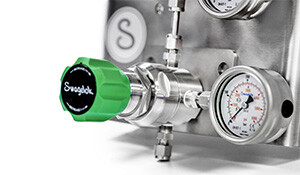
3. Why pressure regulators are the Achilles' heel of many systems
Question: What makes pressure regulators so vulnerable in hydrogen?
Answer:
"They are incredibly sensitive to contamination. Just one damage of a few microns on the seat - so small you can't see it with the naked eye - can cause significant leakage. And that happens especially during startup, when small particles can still be present in the system."
He explains how these damages occur: during filling, from microparticles that have passed filters, from piping that has not been optimally cleaned, or from burrs that occur during assembly.
The result can be that the pressure regulators no longer close exactly or the system exhibits unpredictable behavior, resulting in operators "looking" for a fault they can't find.
Regulator problems often feel like "the system is reacting strangely," when in reality it is one tiny particle that has not been filtered out in time.
That's why he stresses on three principles:
- Always place a filter before the regulator
- Always include seal replacement kit when commissioning
- Always work cleanly
5. Commissioning: the most exciting moment of any system
After installation comes commissioning: the phase when the system first really comes to life and is put into service. According to the engineer, this is the phase where you can win - or lose - everything.
Question: What makes commissioning so critical?
Answer: "Everything is new: materials expand, pressure stabilizes and filters work." But also: it's the time when contamination still in the pipeline can move to critical components. The startup phase is the most vulnerable phase of a system."
A commissioning process done incorrectly, he says, can lead to the following problems, each with substantial consequences for the system and operations. Consider, for example, damaged controllers. This can necessitate costly repairs and often causes unplanned system downtime, causing production or operational delays. Or incorrect pressure settings increase the risk of unsafe situations, such as leaks or explosions, and can seriously affect system reliability. If there is unpredictable flow, it gives unstable or unexpected flow and can disrupt processes, resulting in variations in product quality or damage to sensitive components. You may encounter leaks that seem untraceable. These leaks are difficult to detect, making maintenance more complex, costly and potentially dangerous. And finally, false indications in detection systems may occur. Unreliable sensor information can result in problems not being detected in a timely manner, with all the implications for safety and efficiency.
So what are the solutions to these challenges?
For a successful commissioning process, it is essential toslowly pressurize the system. Pressurizing the system gradually prevents damage and gives room to detect anomalies. Always keep measuring and continuously monitoring parameters ensures that any problems are noticed immediately. Be sure to take your time. Working carefully and without time pressure is conducive to system quality. Keep investigating every anomaly. Deviations should not be ignored, but thoroughly analyzed. And finally, the advice is never to "just push through" something when something is wrong. Continuing despite errors can lead to bigger problems; stopping and correcting is always necessary.
7. Scaling up: why larger systems have different risks
Scaling up is often seen as a "bigger version of the same system."
In reality, it is a completely new discipline.
Question: What risks only arise when scaling up?
Answer:
"Discipline does not automatically scale. You build a pilot with three people who can explain everything to each other. A complete plant you build with hundreds of people. Then consistency becomes the biggest risk." It can be imagined that the larger the plant, the greater the number of connections with a chance of variation in assembly, the greater the dependence on procedures and the impact of one small mistake.
It is the phase when project management, documentation and training suddenly become more decisive than technology.
In conclusion: what we learn from Part 2
Part 2 shows that hydrogen is not a business of big statements, but of small details.
The quality of a system is determined by many different components such as: choice of materials, fittings, cleanliness, pressure regulators and detection. This combined with commissioning, maintenance plan and discipline on all fronts. And - more than anything - by attention. Because the smallest molecule in the world compels us to the greatest craftsmanship.
The journey of hydrogen 1 — Why hydrogen is more difficult than it seems
Top 5 Hydrogen Infrastructure Best Practices